The Facts on FAKs
Stay ahead in freight and supply chain with expert tips, industry news, and deep dives from the 2PL Advisors team
Carrier recommendations
Tailored to your needs and lanes.
Onboarding support
For a faster and easier setup process.
No cost to you.
Our clients pay nothing for our services.
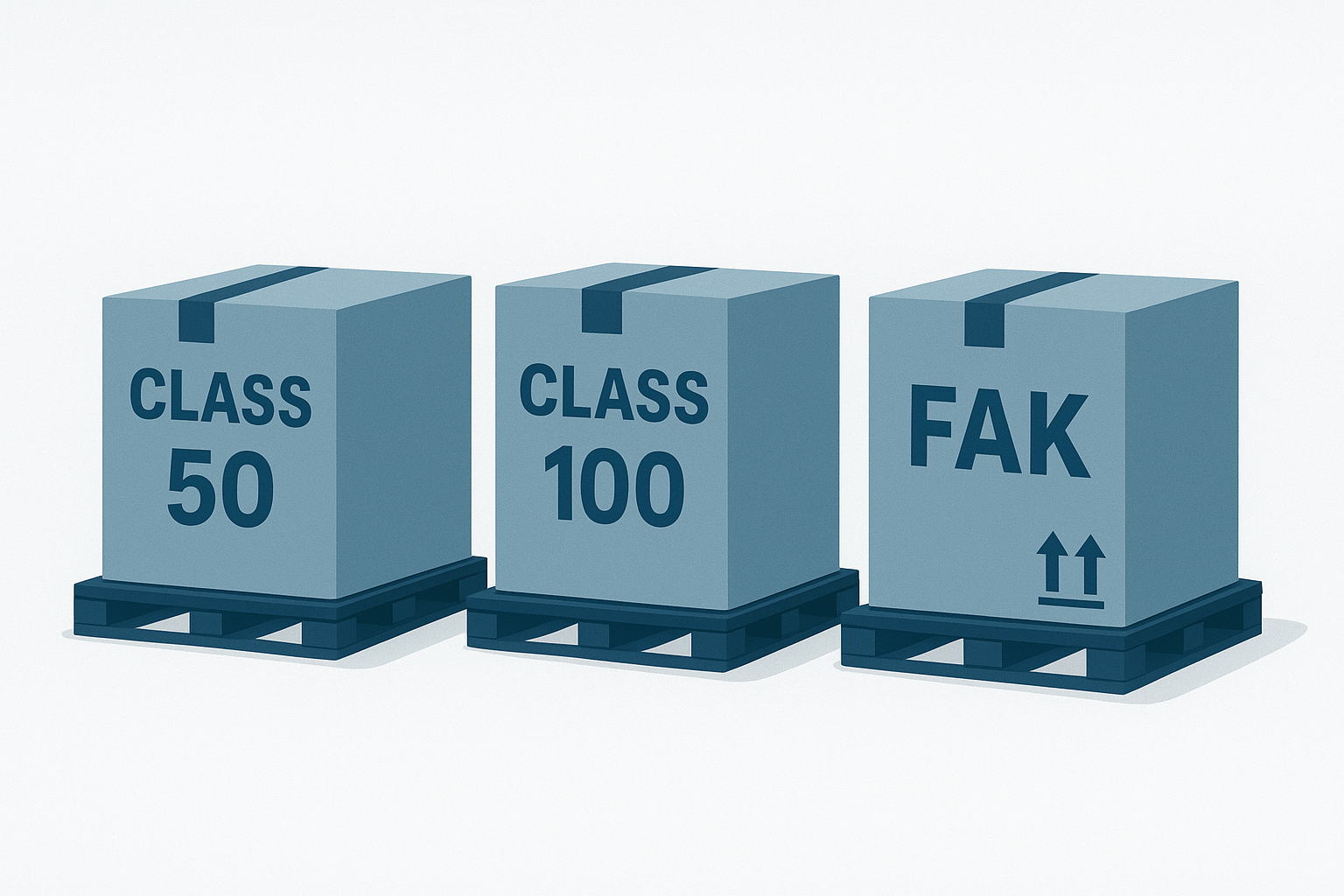
As LTL advisors, shippers often come to us with questions about freight class and FAKs, such as “What are FAKs?”, “When should we use one?”, and “How wide should an FAK band be?” LTL pricing involves many factors - FAK agreements are often another one of these factors, and can be a useful tool to leverage when done right. In this article, we’ll discuss the use of freight classes and FAK structures, examining the ways in which both affect pricing and can benefit shippers.
At its core, the idea behind LTL is simple: shippers pay for the space their freight takes up on a trailer, unlike in truckload, where shippers pay for the entire trailer. Think of LTL as like buying a ticket on a major airline instead of renting a private jet. Because of this, shipments are placed alongside freight from other shippers both in trailers and at carrier terminals, with protective measures in place depending on the commodity. Not all freight is equivalent, though, differing in factors such as density (pounds per cubic foot), handling, stowability, and liability. This difference led the National Motor Freight Traffic Association to create freight classifications, a scale for cost rating in order to fairly price varying types of products. The NMFTA also established the National Motor Freight Classification (NMFC) system to define commodities, establishing provisions that narrow down freight classes depending on the qualities of a given product. Notably in July 2025, the NMFTA updated a majority of NMFCs to be rated on density using a 13 subclass scale, ranging from class 50 to class 400. The details of this scale are outlined below:

While this 13 subclass scale is an effective tool to fairly price commodities, it can also be confusing for shippers with diverse types of freight. Depending on pallet weights and dimensions, products may vary in density and therefore freight class: keeping up with the variety can be especially challenging for high volume shippers. A small difference in packaging could alter the calculated density, causing pallets of the same product to have different freight classes. In addition, LTL carriers perform routine inspections on pallets, reweighing, measuring, and thereby recalculating density and rerating shipments.
This is where an FAK (Freight of All Kinds) agreement comes in. An FAK aggregates a group of multiple classes into one single class for rating. For example, products that are shipped at classes 50, 55, 65, and 70 may be condensed into and priced as a single class 50. It’s important to keep in mind that the FAK applies on the carrier’s end: shippers should still put the appropriate freight class on BOLs in order to ensure pricing accuracy. Multiple FAK bands can be present in an agreement, depending on the freight details and the class spread. FAK structures are negotiated directly with carriers during the RFP process and implemented in published tariffs.
FAKs are not a catch all, however. If the requested band is too wide, combining too many classes under one FAK, carriers will respond in kind and increase rates to offset the risk they are taking with such a broad range of densities. That being said, it’s important to recognize when an FAK is appropriately banded. At 2PL Advisors, we are experts in this area, helping shippers determine an optimum FAK structure by analyzing their products, densities, NMFC numbers and pools of freight classes. During the RFP process, we negotiate a uniform FAK structure (along with other pricing aspects such as base rates, fuel, and accessorials) across a shipper’s carrier base. In this way, the FAK bands are standardized, allowing for direct cost comparison between carriers participating in the LTL bid as well as post-RFP analysis once rates are published.
FAK agreements can provide many benefits for shippers, the primary being cost reduction for higher class shipments. FAKs also simplify the billing and auditing process, and can reduce the impact of carrier inspections. High-volume shippers that have a diverse range of products and freight densities benefit from having FAK structures in place. Even for shipments with the same types of freight, density and class may change due to minor differences in packaging: FAK agreements protect shippers from those types of small discrepancies. FAKs can also be helpful for shippers facing technological gaps, as some transportation management systems (TMS) and warehouse management systems (WMS) are not capable of listing multiple classes on BOLs.
When done effectively, FAKs can be a valuable tool to reduce cost and simplify billing and auditing. These benefits increase tremendously when an FAK structure is standardized across a carrier base. However, determining an appropriate FAK structure requires expertise: if an FAK band is too broad, it could increase rates in certain class ranges for the shipper and negatively impact business. At 2PL Advisors we assist shippers with determining optimum FAK structures, negotiating on their behalf with carriers during the LTL bid process. Our goal is to take away the guesswork and develop effective solutions for our clients—FAK agreements are one of many tools that we leverage to drive cost savings. As always this is done all directly with carriers, no brokerage and no direct cost to the shipper.
Find out more about our LTL RFP Management here: https://www.2pladvisors.com/ltl-rfp-management
Request Demo
More Articles

Become more strategic. Save time. Save money.
With expert analysis and carrier connections, we design a transportation network that can perform better for you.